In January, I introduced you to the folkloristics of material culture via the Maggie Wall Witch Monument near Dunning in Perth and my visit there in November 2025. Material culture is a broad topic covering everything from traditional recipes to vernacular architecture, but my specific interest was in shrines as places of cultural memory. I also discussed the concern Perthshire locals have about "ritual litter" at the monument but concluded that I was more comfortable with the votive offerings there than I was with the ones I had seen at Dunino Den earlier in the day. This dispatch continues that discussion.
I'll begin with a passage from my travel journal:
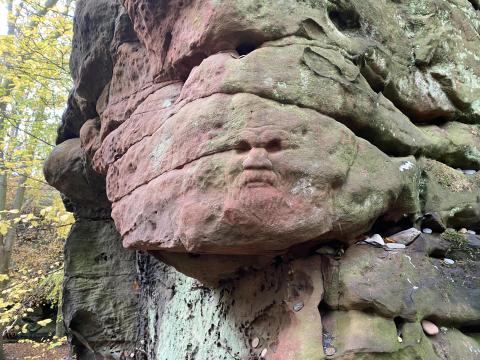
Tuesday, November 4, 2025: I arose early, packed a thermos of tea and lunch, and drove two and a half hours to the far end of Fife and Dunino Den, which lies below Dunino Chapel. I have little sure knowledge about the place, but it has clearly been in use as a ritual site since the Stone Age. A narrow, stone stair arcs down through the rock. On the wall of the stair, a pattern is carved into the rock. At the bottom and around the den, a man's face is carved into another rock wall. There is an altar and a fire pit in the centre of the space, but they felt cluttered and out of place to me, so I wandered a bit more until I saw two trees rising next to each other at the edge of the stream. I made an offering of my homemade incense there, which is comprised of dried lilac, rose, cedar, and rowan from my land along with a bit of resin to help it burn. Then I went to the overhanging rock wall, stepped into the shallows, and filled two water bottles. Afterward I sat by the shallows a while. The energy felt good and restful there.
I offer this excerpt for a few important reasons. First, I'm a folklorist ethnographer trained to be transparent in my ethnographic work, and this dispatch is primarily autoethnographic. So I want you to know where I'm coming from. Second, I saw Dunino Den as a sacred place with a long history of use as a ritual site. I went as a pilgrim and not a tourist, and I made an offering of dried herbs and tree resin at the stream there. In this respect, I'm not so different from other people who went before me. Third, I wanted to show you that I was troubled by the altar and fire pit when I first saw them. This is where my impressions of Dunino and Maggie Wall diverge, because I wasn't troubled by the votive offerings at the Maggie Wall Witch Monument. Finally, I had a sense of both the physical and metaphysical atmosphere at Dunino Den. In fact, some of my impressions were echoed on the VHS cassette I captured for this dispatch. The cassette was in bad shape, and I was only able to capture the audio. But on it, a visitor tells an interviewer that she was uncomfortable photographing the place. Despite my evidence to the contrary in the photos included here, I felt the same discomfort. There were places in Dunino Den I couldn't bring myself to photograph.
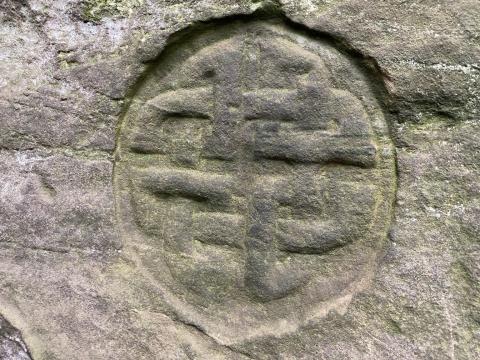
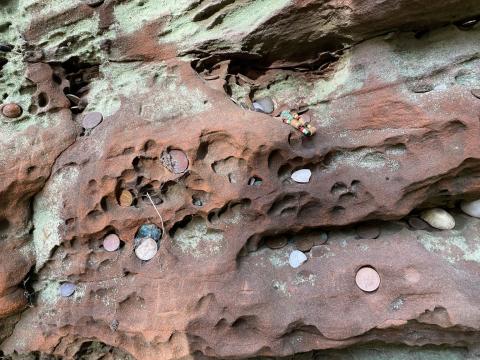
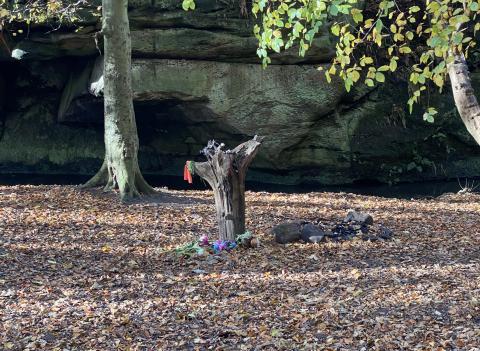
As a folklorist, I was struck by the layering of material culture on this lovely natural den. The stairs, the knotwork pattern, and the face were all part of an ancient layer difficult to interpret, though it was clear that ancient people wanted easier access to the den and marked it as special to them. The cross in the rock came later, a second layer, perhaps a Christian response to the first. A third layer was comprised of old coins jammed into the cliff wall. One of my travelling companions reflected that because coins were valuable to people of modest means, they might represent significant offerings to those who made them. The final layer was wholly contemporary; painted stones, flowers, beads, photos, juggling balls, and even a blue hair clip. Another travelling companion told me she thought perhaps local Pagans came on occasion to collect the offerings and dispose of them in an appropriate manner. These layers of material culture were fascinating to me; each one representing an effort on the part of the person who left them to interact with something they thought was already there.
Another passage from my travel journal:
After a while, I sat on a stone and looked out across the hillside, where the sun was streaming through the trees. As I sat, I felt a strong, sweet blessing descend over me. J. was drawn to the same spot later and stood there for a time while I spoke with A. We parted company soon after, and we all agreed that it was better to leave a song than a stone in natural sacred places. I also quoted Matsuo Bashō to A.: "Do not seek to follow in the footsteps of the wise; seek what they sought" only I paraphrased it as "Do not seek after the ancestors; seek what they sought."
I respect the concerns of Perth and Fife locals about the "ritual litter" left at Maggie Wall and Dunino, and I share their concerns. These places see hundreds of visitors a year, and many of us want to have conversations with them, however brief. I certainly did. But while the conversation at Maggie Wall might be with the cultural memory of murdered women, the conversation with Dunino must be with something else entirely. J., A., and I understood it as the spirit or spirits of place whose presence there precedes any rock carving, coin, or clootie.
I wrote in January's dispatch that "whatever their intended meaning, the votive offerings at the Maggie Wall Witch Monument and indeed the monument itself were created and deposited by humans for humans, living, dead, or imaginary. There is a sense of conversation with people, past and present, anchored in religious abuse, betrayal, murder, condemnation, and remembrance." Of course, not every person visits a shrine for the same reasons. Indeed, folkloristics teaches us that every person's reasons are unique, however similar they might be. But inasmuch as visitors to Dunino Den are seeking to converse with that place in the offerings they leave, they are following in the footsteps of people who conversed with that place in the carvings they made in the rock. What were the ancients conversing with? What was there before them? The folklorist in me can't answer that question, but the animist says "the place itself."
This is why I was so uncomfortable with the altar and fire pit. I couldn't imagine that the trees, the stream, or the stones of Dunino Den would have any use for a blue hair clip, a coin, or even a carving. Perhaps the apple, flowers, or herbs in my incense might nourish them a little, but how much better would it be if we left no material culture at all? What if we came with a prayer, a poem, a song, or even the reading of a tale about Dunino like Katherine Mary Briggs' "A Vision at Duning"?[1] What if we went away and made art about what we experienced there? And if an offering implies a transaction, "a gift for a gift" as we say in Nordic Animism, what is the best possible gift we could offer a place like Dunino Den but to remind others that whatever complexity of physical and metaphysical life we found there, it is sacred in its own right and deserves to be left as we found it?
I left Dunino Den with these questions, and I will leave them with you now. Meanwhile, both the folklorist and the animist in me hope your conversations with the natural world are a blessing; for you and for the places you visit.
By Leaf, Stone, and Water,
Ceallaigh
| 
|
Footnotes
- Briggs, Katharine Mary. British Folk Tales and Legends: A Sampler. London: Granada, 1977: 270-271.
Dr. Ceallaigh S. MacCath-Moran holds B.A. in Celtic Studies from the University of Toronto, an M.A. in English and Creative Writing from the University of Maine, and a PhD in Folklore from Memorial University of Newfoundland and Labrador. She's also an author, poet, and musician under the names Ceallaigh S. MacCath-Moran and C.S. MacCath. Her long-running Folklore & Fiction project integrates these passions with a focus on folklore scholarship aimed at storytellers, and she brings a deep appreciation of animism, ecology, and folkloristics to her own storytelling. You can find her online at csmaccath.com, folkloreandfiction.com, and linktr.ee/csmaccath.
© 2026 Dr. Ceallaigh S. MacCath-Moran. All rights reserved unless Creative Commons licensing is specifically applied. To read the full "Copyright Statement and Usage Guide," visit https://csmaccath.com/copyright.