This Special Dispatch and the one to follow are rooted in the folkloristics of belief and material culture. I had originally intended to begin with an essay on Dunino Den, an ecologically exquisite ravine below Dunino Church in Fife with carvings in the rock dating back to the Stone Age, but one of the resources I want to consult for that essay is a documentary from the 1980s preserved on a VHS tape. As it happens, I have a working VCR in my attic (or at least, I think it still works), but I don't have an RCA to USB capture device. It's on order, and I expect to have it in a couple of weeks.
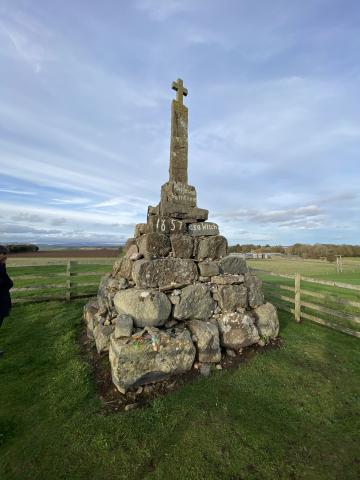
So instead, I'll begin with the women murdered for witchcraft in early modern Scotland and a vernacular shrine that might represent all of them and none of them, the Maggie Wall Witch Monument near Dunning in Perth. I visited the monument on November 4, 2025, the same day I visited Dunino Den southeast of St. Andrews in Fife, but the two sites had very different impacts upon me. In both places, the folklore scholar in my head noted the layers of material culture on the landscape and wondered who among the local residents of Perth and Fife were maintaining these important cultural and spiritual landmarks. But while I realized the votive offerings in both places would likely be viewed as problematic by local residents, the Nordic Animist in my heart was more comfortable with them at Maggie Wall.
Welsh author Geoff Holder asserts in his colourful but well-researched book titled Maggie Wall: The Witch Who Never Was that in spite of the epigraph on the cairn that proclaims "MAggie Wall burnt here 1657 as a Witch," the monument was likely built in the late 18th century. His evidence for this assertion comes from archaeologist David Connolly and places the construction of the cairn over 100 years after the alleged murder. Unlike the Witches' Well in Edinburgh, which was commissioned by Patrick Geddes and designed by John Duncan in 1894,1 the Maggie Wall Witch Monument cannot be traced to a known builder, but Holder speculates it might have been schoolteacher, handyman, and tenant on the property David Balmain.2
Holder's research also points to "Maggie Wall" as a derivation of the place name "Maggie's walls" found on a 1755 map of the area where the monument now stands. This is an interesting finding, since no Perthshire woman named Maggie Wall has ever been found in trial records so precise that "Diligent clerks even put down grim details such as the cost of the peat used for the fire and the rope needed by the executioner."3 So while it's quite clear from the plaque beneath the Edinburgh Witches' Well that Geddes and Duncan were endeavouring to memorialize women murdered nearby, the Maggie Wall Witch Monument has become a vernacular shrine to all of the women murdered as witches in Scotland even though it might be named after a place and not a person.

Folklorist Simon Bronner writes that memorials "are often merely shapes-obelisks and spires serving as resistant marks on the landscape-converting fleeting moments and lives into things to remember."4 But what can we learn from a memorial built for a woman who might never have existed, herself remembered on behalf of so many women who did exist? I'm inclined to agree with other writers who point out the irony of a prominent Christian cross atop a cairn for a woman murdered in the name of Christianity. But as a folklore scholar I can't even speculate that this was intentional because I don't know the builder's intentions. However, I did note during my visit that the painted epigraph wasn't terribly weathered. Holder has information about this as well:
Recent decades have seen some people captivated by the mystery of who renews the paintwork. A legend grew up that a semi-secret society of Dunning women was responsible, their collective aim being to ensure the continuing remembrance of their ‘sister’. The reality is slightly more mundane – local people are proud of the monument (and its mystery) and take care of it, without drawing attention to themselves. The previous repainter was Mrs Sanderson, who lived very close to the monument. When she died the baton was passed on to another long-term resident. I have spoken to the current painter – who last renewed the lettering in 2007 or 2008 – and have promised not to reveal their identity.5
Local residents have also stepped in to restore the monument after it was vandalized and to periodically remove the votive offerings, which Holder describes as "ritual litter," adding that "Local people get a bit fed up with clearing the place up: please do NOT leave anything at the site."6 So whether or not Maggie Wall existed, Dunning residents care about the monument, keep the paint fresh, and clean up after visitors. Local friends who met me there said it was sometimes a destination for school field trips and that Dunning students are taught about the Scottish witch trials. So in addition to being a site of local pride, it's also an educational landmark.
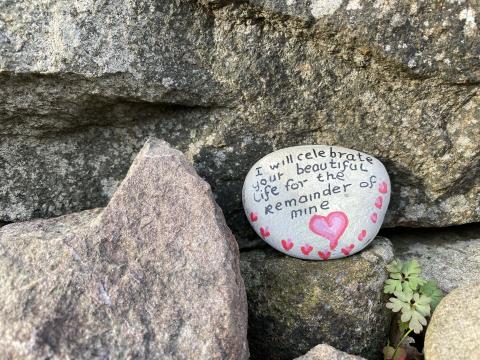
But how are we to interpret the "ritual litter" at the monument? If Holder's discussion is to be credited, these objects come from non-local visitors to the shrine. Folklorists Donald H. Holly Jr. and Casey E. Cordy write that the objects left at several vampire gravesites in Rhode Island are a "window into visitor behavior and belief,"7 and this is certainly the case at the Maggie Wall Witch Monument, which is also a popular destination for supernatural tourism. Holder's 2013 book lists coins, plastic and natural flowers, Halloween toys, pumpkins, a horseshoe, ribbons, pens, candles, shells, crystals, small stones, and stuffed animals, among other things.8 My 2025 photos include tiny broomsticks, a glass globe filled with herbs and incense, a shell, a stone with a tiny Canadian flag painted on it, several other stones with names and dates written on them, and three prominent stones with messages written on them. One was weathered enough to be illegible, one read "I will celebrate your beautiful life for the remainder of mine," and one read "FOR THE FAILED WOMEN OF SCOTLAND. YOU STILL DESERVE SO MUCH BETTER."
To my eye, these objects invite a variety of interpretations. The Canadian flag was likely left by a fellow Canadian visitor; the material culture equivalent of signing a guest book. The flowers and stuffed animals are common enough at memorial sites of all kinds; an outpouring of emotion made tangible in these objects. The candles and coins might be tokens of memory and respect for the dead, but they're also common votive offerings and could be interpreted in other ways. The Halloween toys, the broomsticks, and perhaps the pumpkin reinforce a popular, seasonal understanding of witches. The ribbons echo the Scottish practice of dipping strips of cloth (clooties) in holy wells and tying them to trees as healing charms, and the horseshoe is a traditional ward against evil. The crystals and shells invite the Nordic Animist in me to interpret them because they're often left as sacraments by fellow practitioners of magic who revere the natural world. In the same way, I can identify the glass ball filled with herbs and incense as a Witch Ball, which is a simple spell crafted to ward against evil. Finally, the inscribed stones tell us what they are. Those with names and dates are likely similar to the Canadian flag, and the others express sympathy for Maggie Wall and for the women of Scotland in general. In the last, I hear the voice of a Scottish woman calling out to her fellow countrywomen. But I have no proof of this, so I can't use it as evidence that some of the votive offerings come from regional people whose interactions with the monument differ from those who don't care for these offerings.
Why was the Nordic Animist in me more comfortable with these votive offerings than I was with those at Dunino Den? As you'll see in next month's Special Dispatch, the objects are similar in several respects, though my interpretation of them differs. I'll answer the question more thoroughly in that essay, but I'll close here by writing that whatever their intended meaning, the votive offerings at the Maggie Wall Witch Monument and indeed the monument itself were created and deposited by humans for humans, living, dead, or imaginary. There is a sense of conversation with people, past and present, anchored in religious abuse, betrayal, murder, condemnation, and remembrance. Above all, there is a sense that whether or not Maggie Wall was a real woman, the real women she represents were brutalized by a society eager to hurt them, and her monument stands as a warning that it can never happen again.
Footnotes
- EdinburghGuide.Com. “Witches’ Well.” Accessed January 7, 2026. https://edinburghguide.com/venues/visitor-attractions/witches-well.
- Holder, Geoff. Maggie Wall – The Witch Who Never Was. Kindle. The New Curiosity Shop, 2013: Chap. 5.
- McGrail, Steve. “Maggie Wall Burnt As a Witch.” Dunning Parish Historical Society. Accessed January 7, 2026. https://www.dunning.uk.net/maggie.html.
- Bronner, Simon J. Grasping Things: Folk Material Culture and Mass Society in America. Lexington: University Press of Kentucky, 1986: 14.
- Holder, Geoff. Maggie Wall – The Witch Who Never Was. Kindle. The New Curiosity Shop, 2013: chap. 1.
- Ibid.
- Holly, Donald H., and Casey E. Cordy. “What’s In a Coin? Reading the Material Culture of Legend Tripping and Other Activities.” Journal of American Folklore 120, no. 477 (2007): 336.
- Holder, Geoff. Maggie Wall – The Witch Who Never Was. Kindle. The New Curiosity Shop, 2013: chap. 1.
Dr. Ceallaigh S. MacCath-Moran holds B.A. in Celtic Studies from the University of Toronto, an M.A. in English and Creative Writing from the University of Maine, and a PhD in Folklore from Memorial University of Newfoundland and Labrador. She's also an author, poet, and musician under the names Ceallaigh S. MacCath-Moran and C.S. MacCath. Her long-running Folklore & Fiction project integrates these passions with a focus on folklore scholarship aimed at storytellers, and she brings a deep appreciation of animism, ecology, and folkloristics to her own storytelling. You can find her online at csmaccath.com, folkloreandfiction.com, and linktr.ee/csmaccath.
© 2026 Dr. Ceallaigh S. MacCath-Moran. All rights reserved unless Creative Commons licensing is specifically applied. To read the full "Copyright Statement and Usage Guide," visit https://csmaccath.com/copyright.