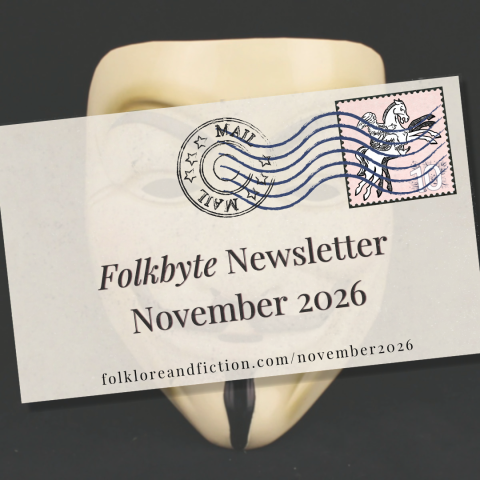
Greetings, and mòran taing for taking the time to read my newsletter. This is the November 2026 edition of Folkbyte, and it comes to you on Guy Fawkes Night eve. More on that below, but for now, onward!
Housekeeping
My apologies to those of you who 1) did not receive my newsletter at all in October, or 2) received it more than once. Our web host experienced a system-wide instability that caused our server to reboot while the newsletter send was in process. (It was a whole thing. Took days to fix. Great Mother. 🤦♀️)
I told a subscriber on Facebook today that even though we're tech savvy folks in this house, sometimes there are glitches when you manage a server and website on your own. Still, given the problems with platforms like Substack and the embedded IP grabs in the ToS of mailing systems like Mailchimp, I think it's better to manage my digital assets in-house. Thank you for being patient with the occasional glitch.
I'll also mention that starting in January, the Folkbyte newsletter will return to a Pagan seasonal schedule, which means it will come to you eight times a year on Samhain (October 31st), the Winter Solstice (around December 21st), Imbolc (February 1st), the Spring Equinox (around March 20th), Beltane (May 1st), the Summer Solstice (around June 21st), Lughnasa (August 1st), and the Autumn Equinox (around September 20th).
The newsletter began this way back when I first started sending it twelve years ago, but the Folklore & Fiction dispatches and podcasts required a monthly schedule and regular social media posts. I'm no longer podcasting, and I've just concluded my scheduled #throwbackthursday series of Folklore & Fiction offerings, so I'm returning to a more animistic schedule, which I have missed.
However, this does mean you'll get the occasional special announcement when I have something of note to share, but you know me. Barring another infestation of server gremlins, you won't often hear from me outside my regular newsletter. On the flip side, you will hear more about Pagan, seasonal, and animistic folklore in the newsletters I do send.
Dispatches from the Word Mines
My contract for The Storyteller's Guide to Folklore is back from my publisher and in the hands of my agent's contract attorneys, so it won't be long before I can tell you the news I've been teasing all year. You'll get a special announcement from me when the ink is dry.
In other news, I took a few weeks off in October to rest and finish a climate fiction writing course I bought last year. I'm back at work on the SGF Material Culture chapter now, and it's coming along nicely.
Remember, Remember
Remember, remember
The fifth of November,
With Gunpowder Treason and Plot;
I know no reason
Why Gunpowder Treason
Should ever be forgot.
Guy Fawkes, Guy!
A stick and a stake
For Queen Victoria's sake!
Holloa, boys! holloa, boys! make the bells ring!
Holloa, boys! holloa, boys! God save the Queen!
Hip, hip, hip, Hurrah![1]
My first exposure to Guy Fawkes lore was in Hannibal, Missouri at the home of a chemist friend who made homemade wine and fireworks. Every year, he celebrated Guy Fawkes Night with a bonfire, and because he threw great parties, I was only too happy to attend. A decade later, V for Vendetta brought me the antifascist reinterpretation of Guy Fawkes lore via Hugo Weaving, Natalie Portman, and Stephen Fry. (I wasn't cool enough to have read the Alan Moore comic first.) For years thereafter, I watched the film every November 5th, often with a fried egg in the basket (until I went vegan) and let the subverted meaning of the traditional poetic sentiment wash over me without really understanding its source. Now, as a folklorist, I know the poem is a part of British oral tradition, existing in many variants across the centuries since Guy Fawkes was tortured and executed for his role in a Catholic plot to blow up the Protestant Parliament and assassinate James I and VI of England.[2]
In the years between Guy Fawkes' death and Hugo Weaving's subversive recitation of a poem that invokes him as a villain, bonfire traditions became a staple of Guy Fawkes' Night celebrations, though they have incorrectly been conflated with Scottish and Welsh Halloween bonfires.[3] Like the nineteenth-century London lads who chanted the rhyme above, asked for coppers, and sometimes set off fireworks,[4] the bonfires and burning in effigy of Fawkes or the Pope appear to be rooted in the gunpowder, treason, and plot. There were Guy Fawkes masks as well, but of course, V for Vendetta revived that part of the tradition with a mask the hacktivist group Anonymous adopted as a symbol of rebellion against tyranny and oppression. More recently, My friend and fellow Pagan priest Andreas bought a Guy Fawkes mask at a Brighton gas station on our way to the Clophill Centre last Samhain, where it was given to a ritual attendee who became the embodiment of invited (and therefore controlled) chaos.
This is what folklore does. It springs from human life, branches into multiple narratives, inspires annual customs, is subverted by popular culture, and takes root in familiar objects like masks. It remains traditional in the hands of some, innovates in the hands of others, and somehow manages to travel forward generation after generation as its own, recognizable self. Where will Guy Fawkes lore travel next? I suppose that depends on the voice you hear in your mind when you read "Remember, remember, the fifth of November." Is it the piping cry of a young British Protestant burning Fawkes or the Pope in effigy, or is it Hugo Weaving's eloquent and subversive V?
Remember, remember, the fifth of November,
Kind masters and mistresses all.
When we're sure to prepare, with Guy Fawkes in a chair,
To give you an annual call.
Guy Fawkes, you all know, tried to overthrow
All who our religion did share.
To establish his hope, the rule of the Pope,
And blow King and the Commons in air.
But he failed in his plan, for King James was the man
Who discovered the plot ere applied,
And determined to trace through every place
Where the villainous plotters might hide.
On discovery bent, for Suffolk he sent,
To search 'neath the Parliament House,
Who gunpowder found hid snug underground,
And Guy Fawkes creeping out like a mouse.
Fawkes by jury was tried, who all did decide
He should be hung on a gallows up high.
Then his carcase they'd take, burn up at a stake
And its ashes let with the wind fly.
Then remember, remember, the fifth of November,
And contribute an halfpenny to buy
Some crackers and rockets; with cash in our pockets
To-night we will pepper old Guy![5]
That's all for now. Wishing you a subversive Guy Fawkes Night worthy of homemade wine. For my part, I'll be planning to attend Saturday's Port Hawkesbury Stop AI Data Centres protest. Wish us luck. And remember, remember: "People should not be afraid of their governments. Governments should be afraid of their people."[6]
Beannachdan,
Ceallaigh
Footnotes
- Hems, Harry. “The Fifth of November: Guy Fawkes Celebrations.” Notes and Queries s10-X, no. 260 (December 1908): 496.
- Historic Royal Palaces. “Guy Fawkes and the Gunpowder Plot.” Accessed November 2, 2026. https://www.hrp.org.uk/tower-of-london/history-and-stories/guy-fawkes-and-the-gunpowder-plot/.
- Hutton, Ronald. Stations Of The Sun. E-Book. Oxford: Oxford University Press, 1996: chap. 39.
- Peacock, Mabel, and C. S. Burne. “Fifth of November Customs.” Folklore 14, no. 1 (1903): 89–90.
- Hems, Harry. “The Fifth of November: Guy Fawkes Celebrations.” Notes and Queries s10-X, no. 260 (December 1908): 496–97.
- McTeigue, James, dir. V for Vendetta. With Hugo Weaving, Natalie Portman, and Rupert Graves. Warner Bros., Virtual Studios, Silver Pictures, 2006. 2h12m.
Dr. Ceallaigh S. MacCath-Moran holds B.A. in Celtic Studies from the University of Toronto, an M.A. in English and Creative Writing from the University of Maine, and a PhD in Folklore from Memorial University of Newfoundland and Labrador. She's also an author, poet, and musician under the names Ceallaigh S. MacCath-Moran and C.S. MacCath. Her long-running Folklore & Fiction project integrates these passions with a focus on folklore scholarship aimed at storytellers, and she brings a deep appreciation of animism, ecology, and folkloristics to her own storytelling. You can find her online at csmaccath.com, folkloreandfiction.com, and linktr.ee/csmaccath.
© 2026 Dr. Ceallaigh S. MacCath-Moran. All rights reserved unless Creative Commons licensing is specifically applied. To read the full "Copyright Statement and Usage Guide," visit https://csmaccath.com/copyright.