Greetings, and mòran taing (many thanks) for taking the time to read my newsletter. This is the January 2026 edition of Folkbyte, a somewhat quiet missive after the torrent of publication news I shared in the autumn! I'll get right to it.
Housekeeping
First, a warm welcome to the many newcomers who signed up for the Folkbyte newsletter in the last several weeks. This is the first of two regular posts you'll receive from me in the course of a month. It's designed to keep you informed about my work, and it arrives on the first Wednesday. The second is the Special Dispatch, a new essay series I tinkered with in the early autumn and will launch in earnest this month. For the most part, these essays sit at the crossroads of academic folkloristics and contemporary Paganism, and the next several of them will discuss various aspects of my recent retreat in Scotland. It arrives on the third Wednesday.
Of note, I had planned to reserve the Special Dispatches for subscribers because of LLM plagiarism concerns, but I've reconsidered that position. While I stand with my fellow academics and artists against the use of our work to train large language models, I will not permit my voice to be diminished by the unethical conduct of plagiarists, digital or otherwise. Silence is the wrong response to the theft of our ideas, our words, and the art we make. So I plan to continue speaking. I hope you will, too.
Finally, you'll note that the Folklore & Fiction archive and the Folkbyte newsletter are managed in-house from my website. One of my other hats is CEO of my family's technology company, so my website is a bespoke piece of work hand-coded by my husband Sean. It's fairly robust, but if you notice any bugs, please report them to me (with a screenshot, if you can). Thanks very much!
Dispatches from the Word Mines
After three months of travel and online course preparation, I'm returning to work on The Storyteller's Guide to Folklore full time until it's completed. The book is out on submission with my agent, so it needs my full attention, and I expect to have it finished in the next six months. In other news, I recently posted a summary of my work in the last year titled 2025 In Review. It was a banner year, the first after finishing my PhD, and I'm proud of what I accomplished in it; the book introductions, the articles, the short fiction, the courses, and everything else. I'm especially grateful for my new agent, Kelly Thomas, and I'm so glad she's on my team.
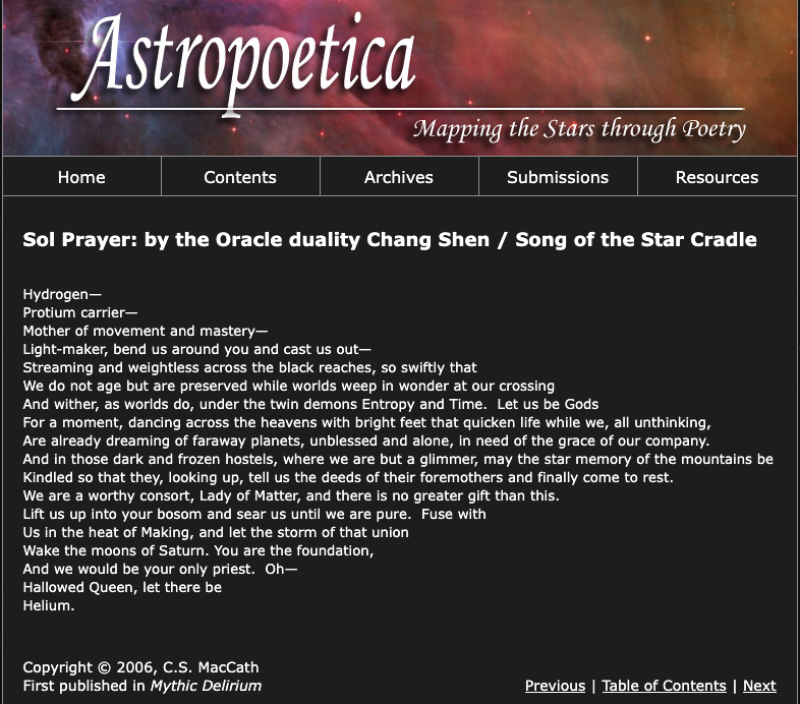
Speaking of the word mines, I've been in them a long time, and I recently had occasion to revisit a poem I wrote some years ago and sold to Mythic Delirium and again later to Astropoetica while those excellent magazines were still in print. It remains available in Astropoetica, but I've screen-capped it for you here as well.1 The poem is drawn from the worldbuilding I did for one of the novel series I have planned after The Storyteller's Guide to Folklore is completed.
From the Folklore & Fiction Archive
In September 2019, I discussed what has come to be one of my favourite folk narrative genres; the fable. In "What is a fable?" I write:
In ancient Greece, fables were included in persuasive verbal arguments to illustrate various moral and ethical points. The same technique might be used in fiction as part of a character's dialogue. In ancient India, fables were placed inside other fables, and a writer might do similar work in fiction by "emboxing" a fable inside a larger tale, either by setting it off as a chapter introduction or by including it in the body of a novel or short story. I would add that much of the Aesopica is quite short; some fables are only a few lines, so it would be simple from a structural point of view to include these pieces of folklore in your writing.2
You can read the whole dispatch here.
Final Thoughts
It will be Imbolc soon; a Gaelic festival held on February 1st with roots in Ireland and Scotland. Dedicated to Brigid, goddess and saint, her blessings of art, beauty, fire, and healing were and remain widely celebrated. Traditional observances include making dolls in the likeness of Brigid and equal-armed crosses made of straw. But I celebrate the festival by making candles I burn on the shrine in my office throughout the year and holding my annual Brigid's Jam whenever possible; a gathering of friends for sacred poetry readings, songs, music, and merrymaking.
'Feill na Bride, feis na finne.'
'Bride binn nam bas ban.'
'A Bhride chaoin cheanail,
Is caoimh liom anail do bheoil,
’D uair reidhinn air m’ aineol
Bu to fein ceann eisdeachd mo sgeoil.'
Feast of the Bride, feast of the maiden.
Melodious Bride of the fair palms.
Thou Bride fair charming,
Pleasant to me the breath of thy mouth,
When I would go among strangers
Thou thyself wert the hearer of my tale.
Beannachd Leibh,
Ceallaigh
Footnotes
- MacCath, C.S. “Sol Prayer: By the Oracle Duality Chang Shen/Song of the Star Cradle.” Astropoetica, July 2014. http://www.astropoetica.com/Summer14/sol-prayer.html.
- MacCath-Moran, Ceallaigh S. “What Is a Fable?” Text. Folklore & Fiction, September 2019. https://csmaccath.com/blog/what-fable.
- Carmichael, Alexander. Carmina Gadelica Volume I. Edinburgh: T. and A. Constable, 1900: 164.
Dr. Ceallaigh S. MacCath-Moran holds B.A. in Celtic Studies from the University of Toronto, an M.A. in English and Creative Writing from the University of Maine, and a PhD in Folklore from Memorial University of Newfoundland and Labrador. She's also an author, poet, and musician under the names Ceallaigh S. MacCath-Moran and C.S. MacCath. Her long-running Folklore & Fiction project integrates these passions with a focus on folklore scholarship aimed at storytellers, and she brings a deep appreciation of animism, ecology, and folkloristics to her own storytelling. You can find her online at csmaccath.com, folkloreandfiction.com, and linktr.ee/csmaccath.
© 2026 Dr. Ceallaigh S. MacCath-Moran. All rights reserved unless Creative Commons licensing is specifically applied. To read the full "Copyright Statement and Usage Guide," visit https://csmaccath.com/copyright.