Greetings, and welcome to the December 2025 edition of the Folkbyte newsletter. I'm back from England and Scotland with a steamer trunk full of folklore I'll be sharing in the Special Dispatch series beginning in January. I had planned to send you a special dispatch on the Winter Solstice, but I'll be reaching out to you twice more this month already, and I don't want to overwhelm your inboxes at Yuletide. As it is, I have an enormous amount of news to share today, so I'll crack on.
The Daily Tomorrow Is Publishing "A Mouth Full of Stones"
I'm delighted to announce that The Daily Tomorrow, a new professional SF magazine with an old-fashioned sensibility, has bought my short story titled "A Mouth Full of Stones" and will be serializing it from December 7th to December 13th. Subscribers will also receive my afterword, which ranges from traditional folklore plots, to marginalized languages, to the heat death of the universe.
The publication of this story signals my return to professional storytelling after a long hiatus, and I couldn't be happier about it. I loved writing "A Mouth Full of Stones", and I hope you'll love reading it. If you're voting next year in the Auroras, Hugos, or Nebulas, I also hope you'll consider "A Mouth Full of Stones" for nomination.
I'll send you a link to the first instalment on December 7th.
New Course! Field Notes for Storytellers: Research, Security, and the Archival Muse
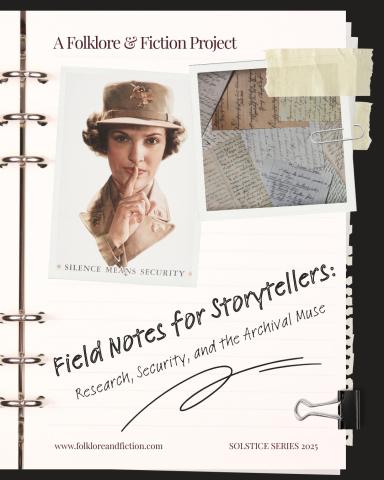
I'm delighted to bring you the first of what I hope will be an annual Winter Solstice course offering! Field Notes for Storytellers: Research, Security, and the Archival Muse fills a wide gap in storytelling instruction by helping you organize and conduct the research that underpins the stories you tell. There are four modules in the course, and each of them draws upon my experience as a storyteller, a folklorist, a doctoral researcher of ethically sensitive topics, and the CEO of a technology company. They are:
"Dodging the Rabbit Hole: Creative Research Workflow for Storytellers"
Good storytelling begins with good research, but it's far too easy to fall down a rabbit hole and get lost on the way to the information you need. "Dodging the Rabbit Hole" offers the remedy for this with a Creative Research Workflow that guides you from brainstorming to writing. Learn how to turn a seed idea into a premise and research question(s), conduct a literature review that serves the story you want to tell, organize your notes into an outline, and turn them into a draft with robust story elements.
"Love That Local Knowledge: Conducting Archival and Ethnographic Research"
Archives and ethnographic interviews are fantastic resources for storytellers, but they're often overlooked in favour of Internet and library counterparts. "Love That Local Knowledge" aims to change that with basic best practices for conducting archival and ethnographic research. Learn what archives are, how to prepare for your visit to an archive, how to conduct research while you're there, and how to cover your ethical and copyright bases when you're working with archived materials. Also learn what ethnography is, how to prepare for and conduct an ethnographic interview, what equipment you need and how to use it, and what ethical, copyright, and archival procedures to follow afterwards.
"Safe Secs: OpSec, InfoSec, and PerSec for Ethnographers, Journalists and Non-Fiction Writers"
Not many people know my doctoral research involved interviewing activists who might have broken the law. And you know what? That's exactly as it should be. But it was difficult and time-consuming to prepare a research plan that protected my informants, my data, and me while I was in the field. "Safe Secs" is for fellow ethnographers, journalists, and non-fiction writers who want to tell important but thorny stories and need to implement extra security measures but don't know where to begin. You'll learn what operational security, information security, and personal security are in relation to sensitive research, basic measures you can take to make your projects more secure, and how these measures played out in my doctoral field work.
"Kit Up: Research and Security Tool Kits for Storytellers"
"Kit Up" follows the Creative Research Workflow in "Dodging the Rabbit Hole" and the InfoSec recommendations in "Safe Secs" with a robust discussion of technology for storytellers. This process-forward module teaches you how to use software solutions for capturing seed ideas, developing your premise and research questions, managing your literature review, organizing your research materials, and formatting your manuscripts. It also provides recommendations for Internet writing aids, submission tracking, and security-forward hardware and software.
Field Notes for Storytellers Handout
The Field Notes for Storytellers handout contains links and descriptions for twenty-two free folklore resources you can download or access right now and dozens of hardware and software options to consider for implementation in your technology and security workflows.
Course Pricing and Availability
Field Notes for Storytellers: Research, Security, and the Archival Muse is priced at $250 CAD, and payment options are available for those who want to pay over time. The course will be housed on the Payhip platform and launch December 18th. I'll email you with a link to it then.
I've Introduced a New Hyldyr Edition of The House of the Wolfings
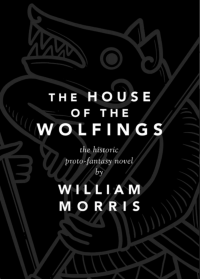
From Hyldyr Publishing House: Equal parts romantic, mysterious, and blood-soaked, William Morris’s legendary and shockingly influential novel The House of the Wolfings is a unique, Old Norse-inspired tale of the ferocious resistance of a group of pagan Gothic peoples against the imperial designs of the ever-hungry, invading Roman Empire. Following the plight of the mysterious Wood-Sun, her lover the war chief Thiodolf (‘the wolf of the people’), and their daughter the Hall-Sun, the Wolfings and their surrounding community band together to fight a powerful, common foe. The House of the Wolfings is widely recognized as core influence on contemporary fantasy fiction, especially on the novels of J. R. R. Tolkien, who took direct inspiration from it and its sequel, The Roots of the Mountains. Rarely in print and long neglected, this unique edition features historical commentary from philologist Joseph S. Hopkins, original art from Jacqui Alberts Lund and Leodrune, and a new introduction from folklorist Ceallaigh S. MacCath-Moran, along with various other supplementary items.
Order The House of the Wolfings here.
My Paper for the 2026 International Society for Folk Narrative Research Symposium "Nature(s) in Narrative" Is Accepted
I'm delighted to report that my paper about the Climate Fiction Writers' League has been accepted for the International Society for Folk Narrative Research symposium titled Nature(s) in Narrative, which will be held in Reykjavik next year. You can view the abstract here.
"Shapeshifting Stories" at the World Fantasy Convention

On November 1st, I moderated a panel at the World Fantasy Convention titled "Shapeshifting Stories." My panellists were authors Abie Longstaff, Lucy Holland, and V.L. Bovalino. The panel was well-attended, and we had a great discussion. Here's the panel description:
Fairy tales, legends, and myths might well be among the most ancient of folk narratives, having their roots in the oral traditions of pre-literate societies. These stories have been reimagined, adapted, and subverted by writers for centuries, from Shakespeare to Disney to Anne Sexton. The 21st century has seen the popularity of such retellings explode, along with new academic interest in their many manifestations. Why? This panel of folk narrative experts seeks to answer this question and many more about the history, meaning, and purpose of these narratives around the world.
The High Seat
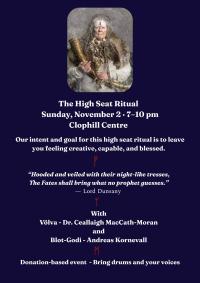
Before I left for the UK, I wrote on social media that those of you who know what a High Seat ritual is also know I did a fair bit of spiritual preparation for the event. I also wrote that I was sensitive to the ocular politics of stepping into a ritual space that is both folkloric and ecstatic as both a scholar and a practitioner. When I returned to Canada, a friend told me that I was altogether "out of the broom closet" now, a term that borrows meaning from the LGBTQ community. Her assertion reminded me that the broom closet, like the queer closet, exists in response to a dominant socio-religious paradigm that has not been and is still not always friendly to Pagans or queer folk. But the space that I occupied on the High Seat, and others like mine, are where the new old stories come into being. And I think we need new old stories, to inspire, instruct, forewarn, and guide us through late stage capitalism and climate Ragnarok into a place where we survive, and the Earth survives with us. I'm going to be down to the wire getting Field Notes for Storytellers out by December 18th, but after that, I'll be writing an autoethnographic account of my experience on the High Seat. I'll let you know when it finds a home. Meanwhile, this was the announcement for the ritual, since you might not have seen it on social media.
From the Folklore & Fiction Archive
In August 2019, I finally got around to discussing the fairy tale in the Folklore & Fiction dispatch series. In "What is a märchen?" I write:
The German word "märchen" and the phrases "fairy tale" and "wonder tale" all refer to the same genre of short prose narratives, in which supernatural beings and other storytelling elements intervene in the everyday lives of people and in which the good are rewarded while the wicked are punished. Folklore scholars sometimes prefer the word "märchen" to its alternatives for the sake of precision; after all, fairy tales don't always contain fairies, and there are many natural wonders worthy of tales. Märchen have also been called "folktales," but this phrase is used in reference to a wide variety of traditional narratives, so it's even less precise than the others...It's been my understanding that straightforward märchen retellings receive a mixed reception among magazine and book editors, so you'll need to innovate with this material. As mentioned before, Disney did this in Maleficent, and I've extolled the virtues of Naomi Novik's novel Spinning Silver in a previous newsletter. More recently, Theodora Goss has released a collection of märchen-themed poems and tales entitled Snow White Learns Witchcraft.
I'm writing this newsletter late, as we weathered our first winter storm and power outage yesterday. But what did I do but light candles and settle down with a good book! It was the rest I didn't know I needed. May your Yuletide season be restful as well, and may the new year find you merry.
Am fear nach dèan an Nollaig sunndach,
Ni e 'Chaisg gu tùrsach deurach.
The man whom Christmas does not make cheerful,
Easter will leave sad and tearful.
Yours from a Cape Breton hearthfire,
Ceallaigh
Dr. Ceallaigh S. MacCath-Moran holds B.A. in Celtic Studies from the University of Toronto, an M.A. in English and Creative Writing from the University of Maine, and a PhD in Folklore from Memorial University of Newfoundland and Labrador. She's also an author, poet, and musician under the names Ceallaigh S. MacCath-Moran and C.S. MacCath. Her long-running Folklore & Fiction project integrates these passions with a focus on folklore scholarship aimed at storytellers, and she brings a deep appreciation of animism, ecology, and folkloristics to her own storytelling. You can find her online at csmaccath.com, folkloreandfiction.com, and linktr.ee/csmaccath.
© 2026 Dr. Ceallaigh S. MacCath-Moran. All rights reserved unless Creative Commons licensing is specifically applied. To read the full "Copyright Statement and Usage Guide," visit https://csmaccath.com/copyright.